Description
High-quality test designs and specifications are the key to precise test cases and an efficient and effective testing process. This hands-on course provides technical test analysts with the ability to define and carry out the tasks required to fulfill the test strategy in terms of technical requirements.
This training course presents a comprehensive overview of methods and techniques for deriving and specifying software tests based on the system’s implementation and structure (“white box tests”). On completing the course, attendees will be able to select and apply techniques for test case derivation such as control flow or data flow testing as well as static and dynamic analysis. We will look at non-functional testing techniques such as reliability testing, portability testing, performance, load and stress testing. We will also discuss how to succeed in building robust automation architectures and using a variety of tools to reach quality targets.
By the end of this course, an attendee should be able to:
- Recognize and classify the typical risks associated with the performance, security, reliability, portability and maintainability of software systems.
- Provide technical elements to the planning, design and execution of tests for mitigating performance, security, reliability, portability and maintainability risks.
- Select and apply appropriate white-box test techniques to ensure that tests provide an adequate level of confidence, based on design coverage.
- Effectively participate in reviews with developers and software architects applying knowledge of typical mistakes made in code and architecture.
- Improve the quality characteristics of code and by making use of different analysis techniques.
- Outline the costs and benefits to be expected from introducing particular types of test automation.
- Select appropriate tools to automate technical testing tasks.
- Understand the technical issues and concepts in applying test automation.
This course covers the International Software Testing Qualifications Board Advanced Level Technical Test Analyst Syllabus 2021 and has been accreditated by an ISTQB-recognized National Board.
This e-learning course has been updated to the latest version of the syllabus! Purchase the course, and get started toward your ISTQB Certification today.
You may book e-learning training only for $799 or optionally add an electronic ISTQB certification exam for an additional $310.
E-learning Demo – View a sample of this course without obligation and for free.
Through presentation, discussion, and hands-on exercises, attendees will learn to:
- Summarize the generic risk factors that the Technical Test Analyst typically needs to consider
- Summarize the activities of the Technical Test Analyst within a risk-based approach for testing activities
- Design test cases for a given test object by applying statement testing to achieve a defined level of coverage.
- Design test cases for a given test object by applying the Decision test technique to achieve a defined level of coverage
- Design test cases for a given test object by applying the modified condition/decision test technique to achieve full modified condition/decision coverage (MC/DC)
- Design test cases for a given test object by applying the multiple condition test technique to achieve a defined level of coverage
- Understand the applicability of API testing and the kinds of defects it finds
- Select an appropriate white-box test technique according to a given project situation
- Use control flow analysis to detect if code has any control flow anomalies and to measure cyclomatic complexity
- Use data flow analysis to detect if code has any data flow anomalies
- Propose ways to improve the maintainability of code by applying static analysis
- Apply dynamic analysis to achieve a specified goal
- For a particular scenario, analyze the non-functional requirements and write the respective sections of the test plan
- Given a particular product risk, define the particular non-functional test type(s) which are most appropriate.
- Understand and explain the stages in an application’s software development lifecycle where non-functional testing should typically be applied.
- For a given scenario, define the types of defects you would expect to find by using the different non-functional test types.
- Explain the reasons for including security testing in a test approach
- Explain the principal aspects to be considered in planning and specifying security tests
- Explain the reasons for including reliability testing in a test approach
- Explain the principal aspects to be considered in planning and specifying reliability tests
- Explain the reasons for including performance testing in a test approach
- Explain the principal aspects to be considered in planning and specifying perfomance testing
- Explain the reasons for including maintainability testing in a test approach
- Explain the reasons for including portability testing in a test approach
- Explain the reasons for including co-existence testing in a test approach
- Explain why review preparation is important for the Technical Test Analyst
- Analyze an architectural design and identify problems according to a checklist provided in the syllabus
- Analyze a section of code or pseudo-code and identify problems according to a checklist provided in the syllabus
- Summarize the activities that the Technical Test Analyst performs when setting up a test automation project
- Summarize the differences between data-driven and keyword-driven automation
- Summarize common technical issues that cause automation projects to fail to achieve the planned return on investment
- Construct keywords based on a given business process
- Summarize the purpose of tools for fault seeding and fault injection
- Summarize the main characteristics and implementation issues for performance testing tools
- Explain the general purpose of tools used for web-based testing
- Explain how tools support the practice of model-based testing
- Outline the purpose of tools used to support component testing and the build process
- Outline the purpose of tools used to support mobile application testing
VIEW DEMO
This course includes the following materials:
| Name | Description |
| Course Outline | A general description of the course along with learning objectives, course materials and an outline of the course topics, including approximate timings for each section. |
| Noteset | A set of approximately 350 PowerPoint slides covering the topics to be addressed. |
| Foundation Sample Exam Questions | A set of approximately 150 pages of review materials for the Foundation level covering every learning objective in the ISTQB Foundation Syllabus. |
| Foundation Mock Exam | A practice exam containing 40 questions and answers to provide a review of the ISTQB Foundation exam. |
| Advanced Technical Test Analyst Sample Exam Questions | A complete set of questions for every learning objective in the Technical Test Analyst module of the ISTQB Advanced Syllabus. |
| Exercise Solutions | A set of approximately 100 pages of detailed solutions for all exercises in the course. |
| Advanced Technical Test Analyst Mock Exam | A practice exam containing questions and answers to assess your readiness for the ISTQB Advanced exam. |
| Project Source Documents for Course Exercises | Specifications used in the realistic example project used in exercises for the course. |
| Bibliography and resources | A set of further readings, Web sites, tools and other resources to help implement the concepts. |
The printed course materials are provided in a mixture of hard copy and electronic format to maximize attendee convenience.
The course runs for three days. For accredited course offerings a minimum of 20 hours of instruction is presented and distributed across the 6 chapters, and the material is covered as described. For custom courses, material may be deleted, added, or expanded upon as needed.
Please note that timings are approximate, depending on attendee interest and discussion. All the lectures include exercises and/or knowledge-check questions except as noted.
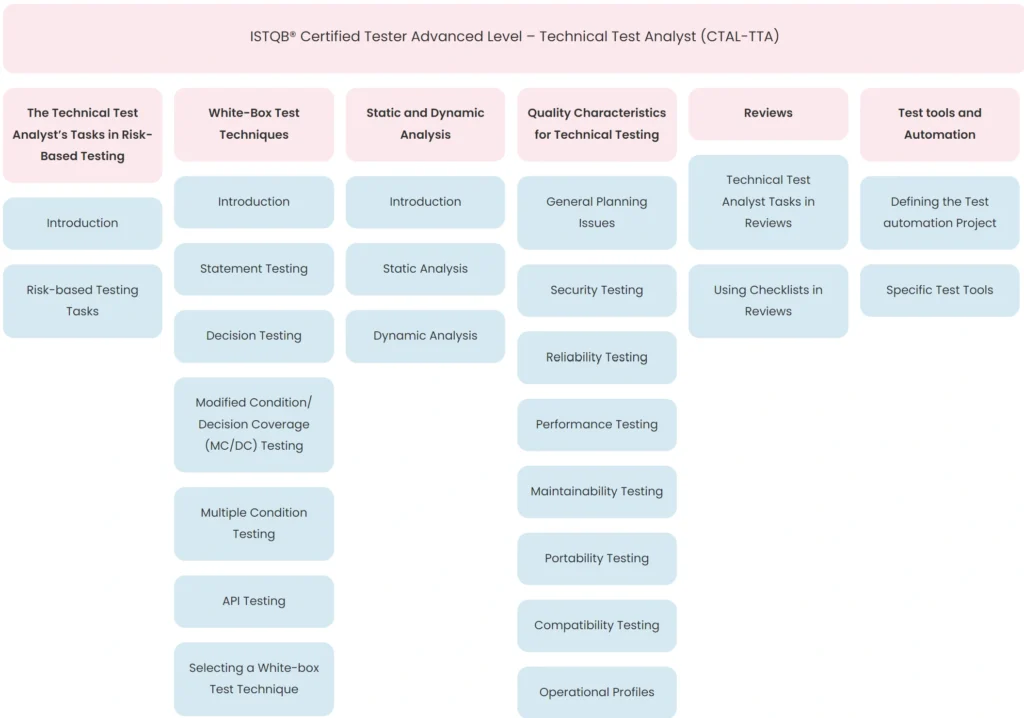
The following shows this session plan in relationship to the chapters and sections of the ISTQB Advanced Syllabus Technical Test Analyst.
Introduction
1.0 The Technical Test Analyst’s Tasks in Risk-Based Testing (30 minutes)
1.2 Risk-based Testing Tasks (30 minutes, no exercises)
2.0 White-Box Test Techniques (300 minutes)
2.1 Introduction (30 minutes, no exercises)
2.2 Statement Testing (45 minutes, no exercises)
2.3 Decision Testing (45 minutes, 1 exercise)
2.4 Modified Condition/Decision Testing (MC/DC) (45 min., no exercises)
2.5 Multiple Condition Testing (45 minutes, 1 exercise)
2.7 API Testing (15 minutes, no exercises)
2.8 Selecting a White-Box Test Technique (75 minutes, 1 exercise)
3.0 Static and Dynamic Analysis (180 minutes)
3.2 Static Analysis (180 minutes, 3 exercises)
3.3 Dynamic Analysis (60 minutes, 1 exercise)
4.0 Quality Characteristics for Technical Testing (345 minutes)
4.2 General Planning Issues (210 minutes, 1 exercise)
4.3 Security Testing (30 minutes, no exercises)
4.4. Reliability Testing (30 minutes, no exercises)
4.5 Performance Testing (30 minutes, no exercises)
4.6 Maintainability Testing (15 minutes, no exercises)
4.7 Portability Testing (15 minutes, no exercises)
4.8 Compatibility Testing (15 minutes, no exercises)
5.0 Reviews (165 minutes)
5.1 Introduction (15 minutes, no exercises)
5.2 Using Checklists in Reviews (150 minutes, 2 exercises)
6.0 Test Tools and Automation (180 minutes)
6.1 Defining the Test Automation Project (105 minutes, 1 exercise)
6.2 Specific Test Tools (90 minutes, no exercises)
Recommended Readings
The class materials include a bibliography of books related to software testing, project management, quality, and other topics of interest to the test professional.
- If you had purchased an exam, an exam voucher will be emailed to you with instructions on how to book the ISTQB certification exam in a separate email
- Remote-proctored exams – The ISTQB Certified Tester exams can be taken online at home via a remote-proctor
- The Advanced Technical Test Analyst Certification exam is comprised of 45 multiple-choice questions, with a pass mark grade of 65% to be completed within 120 minutes
To learn more about ISTQB® exams, consult the Exam FAQs. Take a look at the sample exams made available by ISTQB®. You can find them inside every syllabus folder in Download area.