Description
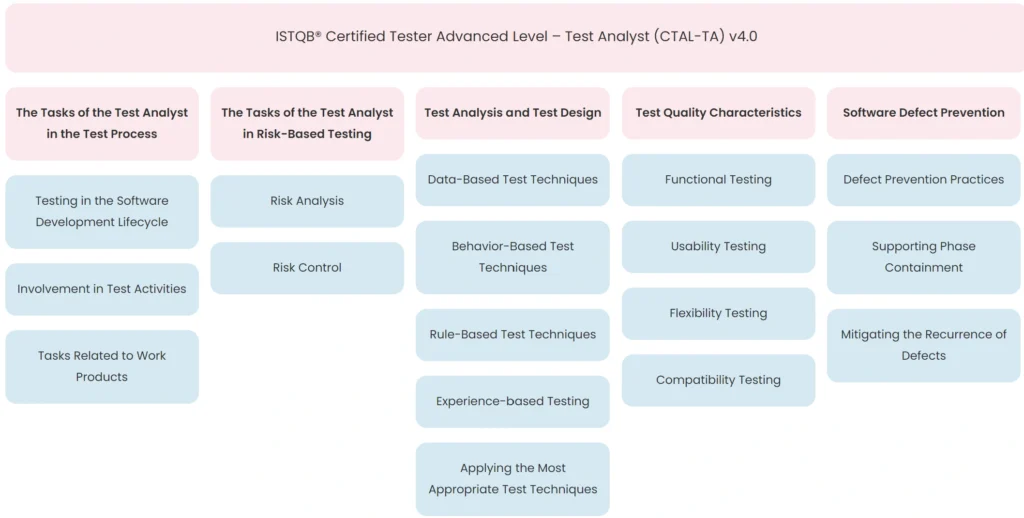
This course provides Test Analysts with advanced skills in test analysis, design, and execution. This hands-on course provides Test Analysts with the ability to define and carry out the tasks required to put the test strategy into action. The course will teach attendees how to analyze the system, taking into account the organization’s and user’s quality expectations. They will learn how to evaluate system requirements as part of formal and informal reviews, leveraging their understanding of the business domain to determine requirement validity. Attendees will learn how to analyze, design, implement, and execute tests, using risk considerations to determine the appropriate effort and priority for tests. Attendees will learn how to implement a testing effort that supports the explicit and implicit testing objectives.
By the end of this course, an attendee should be able to:
- Perform the appropriate testing activities based on the software development lifecycle being used.
- Determine the proper prioritization of the testing activities based on the information provided by the risk analysis.
- Select and apply appropriate testing techniques to ensure that tests provide an adequate level of confidence, based on defined coverage criteria.
- Provide the appropriate level of documentation relevant to the testing activities.
- Determine the appropriate types of functional testing to be performed.
- Work effectively in a usability testing team.
- Effectively participate in requirements/user story reviews, reviews with stakeholders, applying knowledge of typical mistakes made in work products.
- Improve the efficiency of the test process with the use of tools.
Created by Rex Black, President of RBCS, Inc. (www.rbcs-us.com), past President of the International Software Testing Qualifications Board (www.istqb.org), past President of the American Software Testing Qualifications Board (www.astqb.org), and co-author of the International Software Testing Qualifications Board Advanced Syllabus, this course is ideal for testers and test teams preparing for certification. It covers the International Software Testing Qualifications Board Advanced Level Syllabus Test Analyst 2021 and has been accredited by an ISTQB-recognized National Board.
This e-learning course has been updated to the latest version of the syllabus! Purchase the course, and get started toward your ISTQB Certification today.
You may book e-learning training only for $799 or optionally add an electronic ISTQB certification exam for an additional $310.
Through presentation, discussion, and hands-on exercises, attendees will learn to:
- Explain how and why the timing and level of involvement for the Test Analyst varies when working with different lifecycle models
- Summarize the activities performed by the Test Analyst when conducting analysis activities
- Explain why test conditions should be understood by the stakeholders
- For a given project scenario, select the appropriate design level for test cases (high-level or low-level)
- Explain the issues to be considered in test case design
- Summarize the appropriate tasks for the Test Analyst when conducting test implementation activities
- Summarize the appropriate tasks for the Test Analyst when conducting test execution activities
- For a given situation, participate in risk identification, perform risk assessment and propose appropriate risk mitigation
- Analyze a given specification item(s) and design test cases by applying equivalence partitioning
- Analyze a given specification item(s) and design test cases by applying the boundary value analysis
- Analyze a given specification item(s) and design test cases by applying decision table testing
- Analyze a given specification item(s) and design test cases by applying state transition testing
- Explain how classification tree diagrams support test techniques
- Analyze a given specification item(s) and design test cases by applying the pairwise testing
- Analyze a given specification item(s) and design test cases by applying use case testing
- Analyze a system, or its requirement specification, in order to determine likely types of defects to be found and select the appropriate black-box test technique(s)
- Explain the principles of experience-based test techniques and the benefits and drawbacks compared to black-box and defect-based test techniques
- Identify exploratory tests from a given scenario
- Describe the application of defect-based test techniques and differentiate their use from black-box test techniques
- For a given project situation, determine which black-box or experience-based test techniques should be applied to achieve specific goals
- Explain what test techniques are appropriate to test the functional completeness, functional correctness and functional appropriateness
- Define the typical defects to be targeted for the functional completeness, functional correctness and functional appropriateness characteristics
- Define when the functional completeness, correctness and appropriateness characteristics should be tested in the software development life cycle
- Explain the approaches that would be suitable to verify and validate both the implementation of the usability requirements and the fulfillment of the user’s expectations
- Explain the role of the Test Analyst in interoperability testing including identification of the defects to be targeted
- Explain the role of the Test Analyst in portability testing including identification of the defects to be targeted
- For a given set of requirements, determine the test conditions required to verify the functional and/or non-functional quality characteristics within the scope of the Test Analyst
- Identify problems in a requirements specification according to checklist information provided in the syllabus
- Identify problems in a user story according to checklist information provided in the syllabus
- For a given scenario determine the appropriate activities for a Test Analyst in a keyword-driven testing project
- Explain the usage and types of test tools applied in test design, test data preparation and test execution failure
VIEW DEMO
This course includes the following materials:
| Name | Description |
| Course Outline | A general description of the course along with learning objectives, course materials and an outline of the course topics, including approximate timings for each section. |
| Noteset | A set almost 400 PowerPoint slides covering the topics to be addressed. |
| Foundation Sample Exam Questions | A set of approximately 150 pages of review materials for the Foundation level covering every learning objective in the ISTQB Foundation Syllabus. |
| Foundation Mock Exam | A practice exam containing 40 questions and answers to provide a review of the ISTQB Foundation exam. |
| Advanced Test Analyst Sample Exam Questions | A complete set of questions for every learning objective in the Test Analyst module of the ISTQB Advanced Syllabus. |
| Exercise Solutions | A set of approximately 100 pages of detailed solutions for all exercises in the course. |
| Exercise Templates | A set of templates providing guidance for solving the exercises. |
| Advanced Test Analyst Mock Exam | A practice exam containing questions and answers to assess your readiness for the ISTQB Advanced exam. |
| Project Source Documents for Course Exercises | Specifications used in the realistic example project used in exercises for the course. |
| Bibliography and resources | A set of further readings, Web sites, tools and other resources to help implement the concepts. |
The course materials are provided in electronic format. If requested and purchased separately a hard copy of the course materials can be provided.
The course runs for three days. For accredited courses a minimum of 20 hours and 30 minutes of instruction is presented and distributed across the 6 chapters, and the material is covered as described. For custom courses, material may be deleted, added, or expanded upon as needed.
Please note that timings are approximate, depending on attendee interest and discussion. All the lectures include exercises and/or knowledge-check questions except as noted.
The following shows this session plan in relation to the chapters and sections of the ISTQB Advanced Syllabus Test Analyst.
Introduction
1.0 The Test Analyst’s Tasks in the Test Process (150 minutes)
1.2 Testing in the Software Development Lifecycle (15 minutes, no exercises)
1.3 Test Analysis (15 minutes, no exercises)
1.4 Test Design (105 minutes, 1 exercise)
1.5 Test Implementation (15 minutes, no exercises)
1.6 Test Execution (15 minutes, no exercises)
2.0 The Test Analyst’s Tasks in Risk-Based Testing (60 minutes)
2.2 Risk Identification (5 minutes, no exercises)
2.3 Risk Assessment (5 minutes, no exercises)
2.4 Risk Mitigation (50 minutes, 1 exercise)
3.0 Test Techniques (630 minutes)
3.2 Black-Box Test Techniques (540 minutes, 7 exercises)
3.3 Experience-Based Test Techniques (90 minutes, 1 exercise)
3.4 Applying the Most Appropriate Technique (75 minutes, 1 exercise)
4.0 Testing Software Quality Characteristics (180 minutes)
4.2 Quality Characteristics for Business Domain Testing (165 minutes, 1 exercise)
5.0 Reviews (120 minutes)
5.2 Using Checklists in Reviews (120 minutes, 1 exercise)
6.0 Test Tools and Automation (90 minutes)
6.2 Keyword-Driven Testing (60 minutes, 1 exercise)
6.3 Types of Test Tools (15 minutes, no exercises)
Recommended Readings
The class materials include a bibliography of books related to software testing, project management, quality, and other topics of interest to the test professional.
- If you had purchased an exam, an exam voucher will be emailed to you with instructions on how to book the ISTQB certification exam in a separate email
- Remote-proctored exams – The ISTQB Certified Tester exams can be taken online at home via a remote-proctor
- The Advanced Test Analyst Certification exam is comprised of 45 multiple-choice questions, with a pass mark grade of 65% to be completed within 120 minutes
To learn more about ISTQB® exams, consult the Exam FAQs. Take a look at the sample exams made available by ISTQB®. You can find them inside every syllabus folder in Download area.