Description
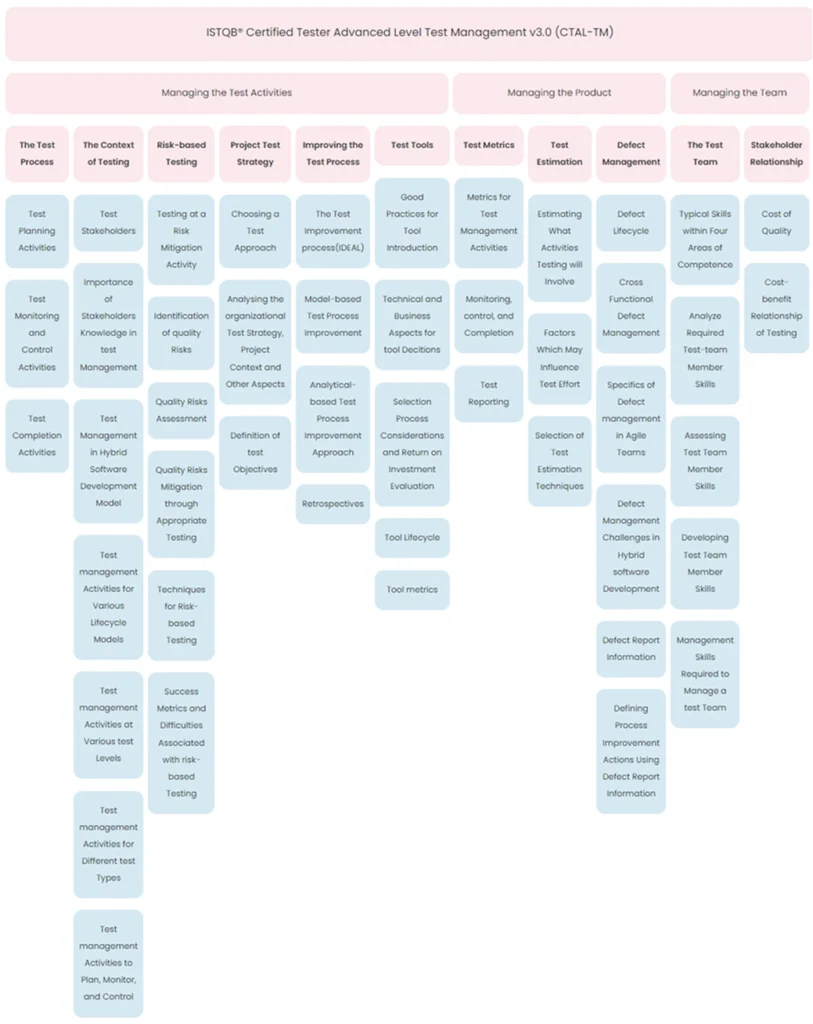
This course provides test managers, test analysts, test engineers, test consultants, test coordinators, test leaders and project managers with advanced skills in test management. Attendees will learn about the two main roles in testing and defining the test strategy. They will gain hands-on experience in planning test activities, monitoring and controlling the test progress, reporting test results and managing test risks and issues. They will return to work able to ensure that test objectives align with the business and stakeholder needs. They will also learn to perform test evaluation, defect management and test closure activities. Further, they’ll learn about test tools and automation to support the test process and improve efficiency and effectiveness.
By the end of this course, an attendee should be able to:
- Manage testing in various software development projects by applying test management processes established for the project team or test organization
- Identify test stakeholders and software development lifecycle models that are relevant in a given context
- Organize risk identification and risk assessment sessions within any software development lifecycle and use the results to guide testing to meet the test objectives
- Define a project test strategy consistent with the organizational test strategy and project context
- Continuously monitor and control testing to achieve project goals
- Assess and report test progress to project stakeholders
- Identify necessary skills and develop those skills within your team
- Prepare and present a business case for testing in different contexts that outlines the costs and expected benefits
- Lead test process improvement activities in projects or software development product streams and contribute to organizational test process improvement initiatives
- Plan the test activities including the required test infrastructure and estimate the effort required to test
- Create defect reports and a defect workflow suitable for a software development lifecycle
This course is also ideal for testers, test managers and anyone involved in the management of software testing who are preparing for certification. It covers the International Software Testing Qualifications Board Advanced Level Syllabus Test Management v3.0 and has been submitted for accreditation by an ISTQB-recognized National Board.
This e-learning course has been updated to the latest version of the syllabus! Purchase the course, and get started toward your ISTQB Certification today.
You may book e-learning training only for $849 or optionally add an electronic ISTQB certification exam for an additional $350.
Through presentation, discussion, and hands-on exercises, attendees will learn to:
- Summarize test planning
- Summarize test monitoring and test control
- Summarize test completion
- Compare why different stakeholders are interested in testing
- Explain why stakeholders’ knowledge is important in test management
- Explain testing in a hybrid software development model
- Summarize test management activities for various software development lifecycles
- Compare test management activities at various test levels
- Compare test management activities for various test types
- Analyze a given project and determine test management activities that emphasize test planning, test monitoring, and test control
- Explain the various measures that risk-based testing takes in order to respond to risks
- Give examples of different techniques a test manager can use for identifying risks related to product quality
- Summarize the factors that determine the risk levels related to product quality
- Select appropriate test activities to mitigate risks according to their risk level in a given context
- Differentiate between heavyweight and lightweight examples of risk-based testing techniques
- Give examples of success metrics and difficulties associated with risk-based testing
- Explain typical choices for a test approach
- Analyze an organizational test strategy and the project context to select the appropriate test approach
- Use the S.M.A.R.T. goal methodology to define measurable test objectives and exit criteria
- Explain how to use the IDEAL model for test process improvement on a given project
- Summarize the model-based improvement approach to test process improvement and understand how to apply it on a project context
- Summarize the analytical-based improvement approach to test process improvement and understand how to apply it on a project context
- Implement a project or iteration retrospective to evaluate test processes and discover testing areas to improve
- Summarize the best practices for tool introduction
- Explain the impact of different technical and business aspects when deciding on a tool type
- Analyze a given situation to create a plan for tool selection, covering risks, costs, and benefits
- Differentiate among the stages of the tool lifecycle
- Give examples for metric collection and evaluation by using tools
- Give examples of metrics to achieve the test objectives
- Explain how to control test progress using test metrics
- Analyze test results to create test reports that empower stakeholders to make decisions
- Explain the factors that need to be considered in test estimation
- Give examples of factors which may influence test estimates
- Select an appropriate technique or approach for test estimation for a given context
- Implement a defect management process, including the defect workflow, that can be used to monitor and control defects
- Explain the process and participants required for effective defect management
- Explain the specifics of defect management in Agile software development
- Explain the challenges of defect management in hybrid software development
- Use the data and classification information that should be gathered during defect management
- Explain how defect report statistics can be used to devise process improvement
- Give examples of typical skills needed by test team members within four areas of competence
- Analyze a given project context to determine required skills for test team members
- Explain typical techniques for skill assessments for test team members
- Differentiate between the typical approaches for developing skills of test team members
- Explain skills required to manage a test team
- Give examples of motivating and hygiene factors for test team members
- Give examples for each of the four categories determining the cost of quality
- Apply a cost-benefit calculation to estimate the added value of testing for stakeholders
VIEW DEMO
This course includes the following materials:
| Name | Description |
| Course Outline | A general description of the course along with learning objectives, course materials and an outline of the course topics, including approximate timings for each section. |
| Noteset | A complete set slides covering the topics to be addressed. |
| Foundation Level Sample Exam Questions | A practice exam containing 40 questions and answers to provide a review of the ISTQB Foundation exam. |
| Advanced Test Management Knowledge Checks | Sample exam questions and quizzes integrated with the slides for comprehension checks. |
| Exercise Solutions | Exercise instructions and detailed solutions for all exercises in the course. |
| Advanced Test Manager Sample Exams | Multiple practice exams containing questions and answers to assess your readiness for the ISTQB Advanced Test Management exam. |
| Project Source Documents for Course Exercises | Specifications used in the realistic example project used in exercises for the course. |
| Bibliography and resources | A set of further readings, Web sites, tools and other resources to help implement the concepts. |
The course materials are provided in electronic format. If requested and purchased separately a hard copy of the course materials can be provided.
The course runs for four days. Each day is about 480 minutes of class time, from 9:00 to 5:00 including lunch break and shorter breaks.
Please note that timings are approximate, depending on attendee interest and discussion. All sections include interactive activities, discussions, and exercises (some of which are optional and covered based on time available and attendee interest).
The following shows this session plan in relation to the chapters and sections of the ISTQB Advanced Test Management Syllabus.
Introduction and Review (60 minutes, no exercises):
- 1.0 Managing the Test Activities (750 minutes)
- 1.1 The Test Process (45 minutes, no exercises)
- 1.2 The Context of Testing (165 minutes, 1 exercise)
- 1.3 Risk-Based Testing (150 minutes, 1 exercise)
- 1.4 The Project Test Strategy (150 minutes, 1-2 exercises)
- 1.5 Improving the Test Process (105 minutes, 1 exercise)
- 1.6 Test Tools (135 minutes, 1 exercise)
- 2.0 Managing the Product (390 minutes)
- 2.1 Test Metrics (105 minutes, 1 exercise)
- 2.2 Test Estimation (105 minutes, 1 exercise)
- 2.3 Defect Management (180 minutes, 1-2 exercises)
- 3.0 Managing the Team (225 minutes)
- 3.1 The Test Team (150 minutes, 1 exercise)
- 3.3 Stakeholder Relationships (75 minute, 1 exercise)
Recommended Readings
The class materials include a bibliography of books related to software testing, project management, quality, and other topics of interest to the test professional.
This course was accredited by the ISTQB. This course follows the ISTQB Advanced Level Test Manager Syllabus 2012. Blended e-learning, licenses, and volume discounts are also available for companies. Login instructions are to be emailed.
- If you had purchased an exam, an exam voucher will be emailed to you with instructions on how to book the ISTQB certification exam in a separate email
- Remote-proctored exams – The ISTQB Certified Tester exams can be taken online at home via a remote-proctor
- The Advanced Test Manager Certification exam is comprised of 65 multiple-choice questions, with a pass mark grade of 65% to be completed within 180 minutes
To learn more about ISTQB® exams, consult the Exam FAQs. Take a look at the sample exams made available by ISTQB®. You can find them inside every syllabus folder in Download area.